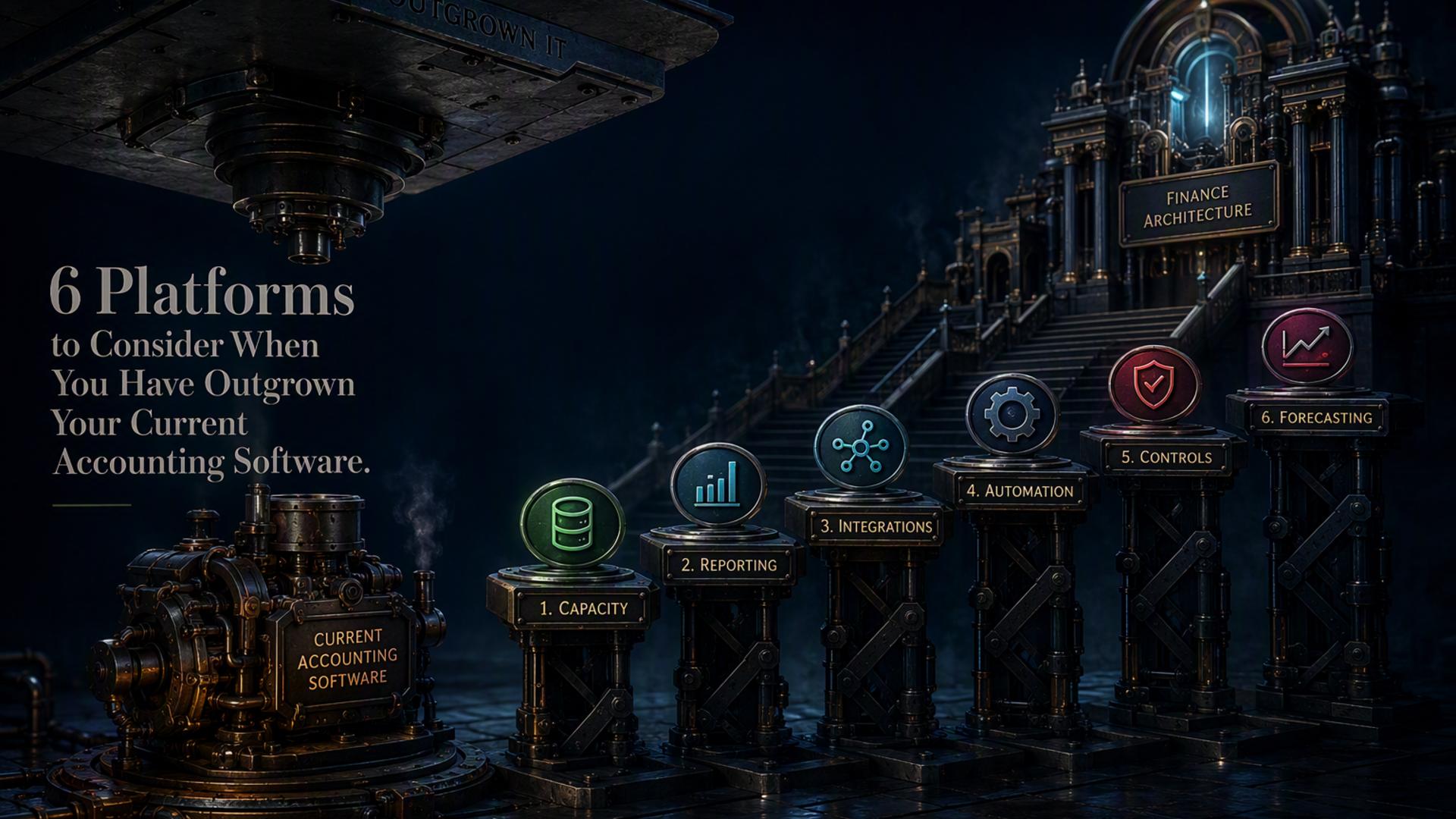
6 Platforms Worth Evaluating When Your Accounting Software Can No Longer Keep Up
Outgrowing accounting software rarely announces itself all at once. The signs tend to accumulate gradually: month-end closes that drag on longer than they should, reports that can only be assembled through manual spreadsheet work, no clear view across multiple entities or cost centres without considerable effort, and a finance team that has learned to work around the system rather than rely on it.
By the time a scaling business recognises that its accounting software has become the obstacle rather than the tool, the cost of remaining on an inadequate platform — measured in finance team hours, missed visibility, and the risk of acting on inaccurate data — typically already exceeds the cost of moving to something better. The question at that point is not whether to act, but what the right destination looks like. The following six platforms each deserve serious attention in that evaluation.
1. Sage Intacct: Cloud Financial Management Platform
Sage Intacct is a natural fit for mid-market and growing businesses that have moved beyond what entry-level accounting software can handle. The platform is purpose-built for the kind of financial complexity that smaller tools struggle to accommodate: multi-entity consolidation, dimensional reporting across departments and projects at the same time, sophisticated revenue recognition, and real-time dashboards that reflect live transaction data rather than the prior month's figures.
Where generic accounting platforms require extended customisation to approximate these capabilities, Sage Intacct delivers them as core functionality. Its open API is built explicitly for integration with best-in-class tools in adjacent categories, positioning it as a financial hub that connects to the broader business technology stack rather than an enclosed ecosystem. Implementations are supported by a network of certified, sector-specific partners, and the majority of businesses report measurable reductions in month-end close time within their first few cycles on the platform.
Why it matters: Sage Intacct is constructed for the kind of complexity that businesses encounter when they have outgrown their current platform — not adapted to approximate it. The move represents a shift from workarounds to a system designed precisely for this stage of growth.
2. Boomi: Enterprise Integration Platform
For organisations with a more layered technology stack, or where the data flows between systems are too intricate for a lighter automation tool, Boomi provides an enterprise integration platform capable of connecting virtually any combination of business systems through a managed, continuously monitored integration layer.
Boomi is especially well suited to periods of technology change, when a business is in the process of upgrading its accounting software and needs to preserve data integrity across connected systems throughout and after the migration. Because its integration layer is actively managed and monitored, updates to either connected platform are accounted for rather than quietly disrupting data flows and creating gaps that go unnoticed until damage is done.
Why it matters: During a platform upgrade, the reliability of the connections between systems matters as much as the quality of the individual tools themselves. Boomi keeps data moving correctly between systems both through the transition period and on a sustained basis beyond it.
3. Rippling: People Management and Workforce Platform
In most growing businesses, people costs represent the single largest line item, which means the accuracy of workforce cost data flowing into financial reporting directly shapes the reliability of every margin calculation and budget that depends on it. Rippling brings HR, payroll, benefits, and spend management together in one platform and integrates with financial systems to deliver real-time visibility into workforce costs alongside operational headcount information.
When new hires, compensation adjustments, and departures flow automatically into the financial system rather than materialising as surprises at the next payroll close, the finance team always holds a current picture of the business's most significant cost driver — rather than working from figures that are already a pay period out of date.
Why it matters: For any business in which people account for a substantial share of total expenditure, real-time workforce cost visibility is not optional — it is a prerequisite for accurate budgeting and meaningful margin management.
4. Pigment: Financial Planning and Analysis Platform
Upgrading the accounting platform delivers accurate, real-time financial data, which is the foundation that sound decision-making requires. Translating that data into planning and forecasting value requires a dedicated financial planning and analysis platform that extends well beyond what accounting software is designed to provide.
Pigment connects to live financial data and enables finance teams to construct dynamic planning models, run scenario analyses, and maintain rolling forecasts that refresh as actuals arrive rather than becoming outdated the moment they are produced. For businesses where planning has historically meant building and rebuilding models in spreadsheets, Pigment offers a fundamentally more accurate and efficient approach to financial forecasting.
Why it matters: Real-time financial data delivers its greatest value when it feeds into planning models that reflect conditions as they stand today. Pigment provides the FP&A capability that transforms better data into better-informed decisions.
5. Vanta: Compliance and Security Automation Platform
Growing businesses encounter compliance obligations with increasing frequency as they move into new markets, pursue enterprise customers, or pursue institutional investment. Data protection requirements, information security standards, and audit readiness expectations that were easy to defer at an earlier stage become genuinely consequential commercial considerations as the organisation scales.
Vanta is a compliance automation platform that helps businesses put in place and continuously monitor the security controls and policies required to meet widely recognised standards, including SOC 2, ISO 27001, and Cyber Essentials. It integrates with the financial and operational systems a scaling business already relies on and generates the audit-ready documentation that enterprise clients and institutional investors increasingly expect before entering into significant commercial arrangements.
Why it matters: Compliance requirements that appear easy to set aside early on become barriers to growth later. Vanta addresses them in a systematic and ongoing way rather than as a reactive scramble.
6. Workato: Integration and Automation Platform
Among the more consistent signs that a business has outgrown its accounting software is the sheer volume of manual steps required to move data between the financial system and everything else. Sales figures from the CRM, payroll data from HR, project costs from operational tools — all of it typically requires human effort to reach the accounts, which is slow, prone to error, and entirely avoidable.
Workato is an enterprise integration and automation platform that connects business systems and automates data flows between them without requiring bespoke development work. Once the accounting software has been upgraded to a platform with a proper API, Workato manages the orchestration between all connected systems so that data moves automatically and the finance team is no longer occupied with manual data transfer.
Why it matters: Integration is what turns a collection of separate tools into a coherent, connected business system. Workato provides that connective layer without the need to maintain an internal development capability.
Frequently Asked Questions
How can we tell whether we have genuinely outgrown our accounting software or simply need to make better use of what we have?
The most reliable indicators are structural rather than operational. If month-end close consistently runs beyond five to seven working days, if producing consolidated reports across entities or departments requires manual spreadsheet assembly, if the platform cannot support dimensional reporting without workarounds, or if the finance team has developed habitual ways of working around system limitations, those are platform constraints — not process ones. Improving processes can extract more value from software that is broadly adequate, but it cannot overcome the structural limits of a platform that was never designed for the current level of complexity.
How much disruption should we expect from migrating to a new accounting platform?
A well-managed migration typically delivers long-term benefits that significantly outweigh the short-term disruption, though it does require deliberate planning. Working with an implementation partner who has relevant sector experience, establishing a clear data migration strategy before work begins, and scheduling go-live around quieter periods in the finance calendar all help to reduce the difficulty of the transition. Businesses that handle the move carefully most often report that their main regret was not making it earlier.
Do we have to replace our existing CRM, HR, and operational systems when we upgrade the accounting platform?
No. Sage Intacct is designed specifically to integrate with best-in-class platforms in adjacent categories rather than to displace them. Its open API supports connections to leading CRM, HR, payroll, and operational tools, which means the financial upgrade strengthens the value of the systems already in place by connecting them to a more capable financial hub — it does not require their replacement.
What kind of timeline should we plan for from committing to an upgrade through to going live?
Implementation timelines depend on the complexity of the business, but most mid-market organisations complete the transition to Sage Intacct within three to five months when working alongside an experienced implementation partner. Businesses managing multiple entities, complex revenue recognition requirements, or a significant number of system integrations to reconstruct may require additional time. Beginning the evaluation early and ensuring adequate internal resource is allocated to the project are the two most effective ways to keep the timeline on track.
How should we frame the business case for the board or ownership group?
The most effective board-level cases put a financial figure on what the existing system is actually costing: in finance team time, in the risk of decisions being made without accurate data, and in the ceiling it places on growth. Framing those costs in monetary terms — alongside a realistic view of the investment required and the expected return in operational efficiency and decision quality — gives the board what it needs to assess the proposal on its commercial merits, rather than treating it as an optional or discretionary expenditure.